Autonomous AI agents for the PMO: the new standard
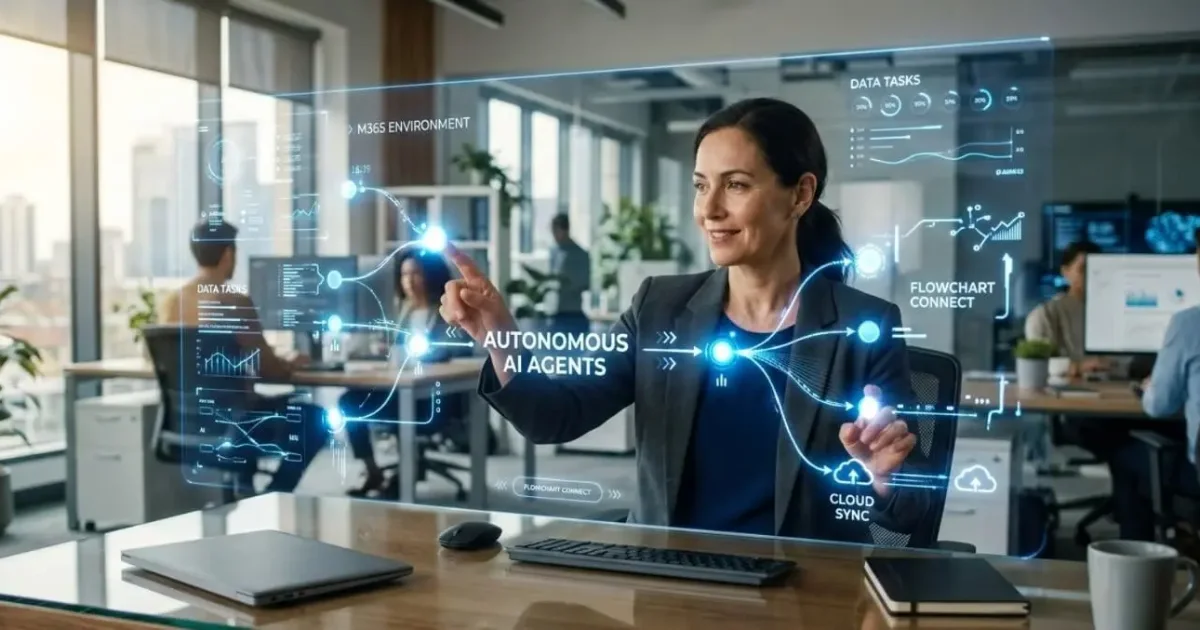
The AI agents for the PMO are creating a turning point thanks to autonomous AI agents. These systems not only operate independently, but also make it possible to anticipate deviations and execute strategic decisions without direct human intervention. Therefore, in a modern PMO, the implementation of autonomous AI agents is the key to transforming day-to-day operations into a model of efficiency and resilience.
As has happened in fields such as cybersecurity, where intelligent automation has become an essential element for anticipating complex risks, AI agents are building a new model of efficiency and resilience within modern PMOs.
Delivery cycles, competitive pressure and the need to act quickly have driven many organisations to adopt work models assisted by cognitive systems. As a result, this places project management in a completely different scenario from the one that existed just a few years ago.
AI agents for the PMO: what they are and how they work
An autonomous agent is an intelligent system capable of analysing information, making decisions and executing actions without constant supervision. However, unlike traditional AI limited to specific tasks, these agents can interact with multiple management tools, interpret historical data, detect patterns and react to unforeseen events.
It is a model with parallels to the automated agents already used in critical sectors such as banking and cybersecurity, where automation makes it possible to stay ahead of the adversary and respond without unnecessary human delays.
AI agents for the PMO: dynamic and adaptive planning
For example, one of the most powerful capabilities of these agents is their ability to recalculate work plans in real time. Every change, incident, an unavailable resource, a delay in a deliverable, triggers an automatic update of the schedule and priorities, reducing the margin for error and avoiding bottlenecks.
Whereas in a traditional approach a change of scope could require hours of manual review, an autonomous agent can adjust task sequences in seconds, apply dependencies and recalculate estimated times without human intervention.
Early risk prediction
Predictive analytics becomes a critical layer of value.
Just as today’s digital attacks use AI to automate campaigns that are impossible to detect with the naked eye, autonomous agents applied to projects can anticipate budget deviations, resource saturation or missed milestones before the team is even aware of them.
This capability makes it possible to take better-informed decisions: triggering preventive actions, renegotiating deliverables or redistributing workload before a problem materialises.
Automation of reporting
In the context of AI agents for the PMO, traditional reporting involves a significant amount of time. Minutes, weekly reports, executive summaries or impact analyses mean hours of manual information gathering.
With autonomous agents, reports are generated automatically from:
- Real project data
- Milestone tracking
- Risk register
- Team workload
- Schedule changes
The information is precise, up to date and consistent. This frees the Project Manager for more strategic tasks and eliminates the risk of documentation errors.
Intelligent resource allocation
Another key aspect of AI agents for the PMO is the distribution of work. The agents can analyse:
- Team availability
- Technical qualifications
- Performance history
- Cognitive load
- Delivery rhythms
With this information, they recommend optimised assignments and detect potential overloads. This helps to balance effort, reduce stress and improve the quality of the final result.
Seamless integration with hybrid environments
Organisations no longer work with a single methodological framework. Combining agile approaches with predictive ones is common, especially in complex projects.
Autonomous agents can operate in both models, since they:
- Adjust tasks in sprints
- Recalculate critical paths
- Manage dependencies between teams
- Analyse agile and traditional metrics in a unified way
They become a natural bridge between different methodologies without adding complexity to the process.
AI agents for the PMO: the new role of the Project Manager
Far from replacing managers, with AI agents for the PMO, AI amplifies their analytical capacity and their impact on the organisation. Just as in cybersecurity automation allows teams to focus on strategy and not on mechanical tasks, in project management the agents leave the Project Manager room to:
- Lead the team
- Communicate clearly
- Make informed decisions
- Manage key relationships
- Resolve conflicts
- Align expectations with stakeholders
The Project Manager is oriented towards strategy and value, not towards bureaucracy.
AI agents for the PMO: security, governance and control
Adopting AI agents for the PMO requires establishing a governance framework of its own:
- Defining limits of action
- Establishing criteria for human supervision
- Aligning AI models with corporate objectives
- Assessing bias and data quality
- Ensuring regulatory compliance
- Integrating cybersecurity considerations
This last point is critical, especially in highly regulated industries. The lessons from sectors such as banking, where AI must be traceable and controlled, can be extrapolated directly to project management.
How to implement AI agents for the PMO
The ideal adoption process is structured in four phases:
- Diagnosis
Identify repetitive processes, administrative efforts and friction points. - Pilot project
Select a well-defined project where the technology can be tested without risk. - Alignment and governance
Establish clear rules, supervision and operational limits. - Progressive scaling
Extend adoption to more projects and areas of the PMO.
This approach minimises risks and maximises effectiveness.
AI agents for the PMO: the new standard
In conclusion, autonomous AI agents represent a new standard for the PMO of the future, in the same way that advanced automation has redefined cybersecurity. The Project Manager does not lose prominence, but rather gains it by delegating bureaucratic tasks.
AI becomes a strategic co-pilot that raises precision and reduces uncertainty at every phase of the project. This new paradigm allows people to concentrate on what no algorithm can replace: vision, communication and human leadership.
Adopting autonomous AI agents today means securing the organisational resilience of tomorrow.
Do you work in banking, insurance or public administration? See also: Implementing AI agents in regulated environments: EU AI Act, risks and project management. or AI agents for the PMO: The Integrated Workflow
Frequently asked questions about AI agents for the PMO
Autonomous AI agents are also changing how software is written. If the assisted-development side interests you, I cover it in vibe coding in the enterprise.
These agents fit within a broader movement that I cover in IT project management trends for 2026.
Autonomous AI agents are artificial intelligence systems capable of making decisions, executing actions and learning from the results without constant human supervision. They combine LLM models (such as Claude, GPT or Gemini), tools (APIs, databases, code execution) and contextual memory. Unlike traditional chatbots, they pursue medium-term objectives and re-plan according to the environment.
A traditional AI assistant responds to one-off requests (ChatGPT, Claude.ai). An autonomous agent pursues complete objectives: it breaks down a task, plans the steps, executes actions (calling APIs, writing code, searching for information), evaluates results and re-plans if it encounters obstacles. Autonomy opens up new capabilities but also introduces risks that must be managed under the EU AI Act.
The most mature use cases are: PMO automation (dynamic planning, reporting), customer service with intelligent escalation, data analysis (SQL queries in natural language), IT incident management (diagnosis and remediation), cybersecurity (proactive threat hunting), administrative processes (invoicing, reconciliation), technical documentation generation and data pipeline orchestration.
More on AI agents for the PMO
The most widely used frameworks are: LangChain and LangGraph (orchestration), CrewAI (collaborative agents), Microsoft’s AutoGen, Semantic Kernel, Anthropic Tools (Claude with native tools), the OpenAI Agents API, n8n (no-code) and Mastra (TypeScript). The choice depends on the language, the complexity of the flow and the level of governance required by the regulated sector.
The main risks are: erroneous decisions with operational consequences, privileged access that can cause harm (deleting data, executing transactions), prompt injection and hijacking of the agent, dependence on LLM providers, uncontrolled costs, and regulatory penalties in sectors covered by the EU AI Act, NIS2 or DORA. Mitigation comes through sandboxing, human supervision in critical decisions and exhaustive logs.
A programme to run with little margin for error? See how I have done it.
See the nine case studies