Digital security is, first and foremost, the everyday layer of defence that protects people, teams and organisations against a threat landscape that evolves every week. Today, new entry vectors are common in any organisation: generative-AI phishing, deepfakes, identity theft, attacks on mobile devices and credential compromise. As a result, it’s no longer a problem exclusive to large corporations, but one for any connected professional.
In this hub I group, on one hand, the articles where I cover applied cyber hygiene: how to build strong passwords and authentication, detect hacking attempts on phones, protect your digital identity and train teams to recognise social engineering. On the other, I step up towards risk management as a leadership discipline and towards a fast-growing front: non-human identities (keys, tokens and AI agents) that now outnumber human ones and are one of attackers’ favourite doors. All the material is designed for professionals who aren’t security specialists but need to make well-informed decisions.
Articles on digital security

How to stop your phone being hacked: a 2026 security guide
Phone hacking: learn how to prevent it with this 2026 cybersecurity guide. Spot malicious apps, unsafe networks and protect your privacy.
Read the full guide
IT security 2026: proactive defence with applied AI
IT security 2026: defensive AI, Zero Trust and NIS2 to protect your organisation with an executable plan this quarter.
Explore this topic
Cybersecurity vs IT security: the key differences
The differences between cybersecurity and IT security: scope and why they aren’t the same. A clear guide for IT companies.
Go deeper here
Managing your digital legacy: protect your inheritance online
Digital legacy: what it covers, tools, the legal framework in Spain and post-mortem protection. A practical guide to planning your digital inheritance.
Read the analysis
Cybersecurity risk management: a strategic guide for companies
Cybersecurity risk management: the cycle, frameworks (ISO 27005, NIST, ENS), business alignment and 2026 trends. A strategic guide for companies.
Read article
Non-human identities: governing AI agents’ access
What non-human identities are, why AI agents and services multiply access risk, and how to govern them with a Zero Trust approach.
Read article
Prompt injection in the enterprise: risks and defences in GenAI projects
What prompt injection is, why it is a critical risk in generative AI projects and what defences to apply to protect your enterprise applications.
Read article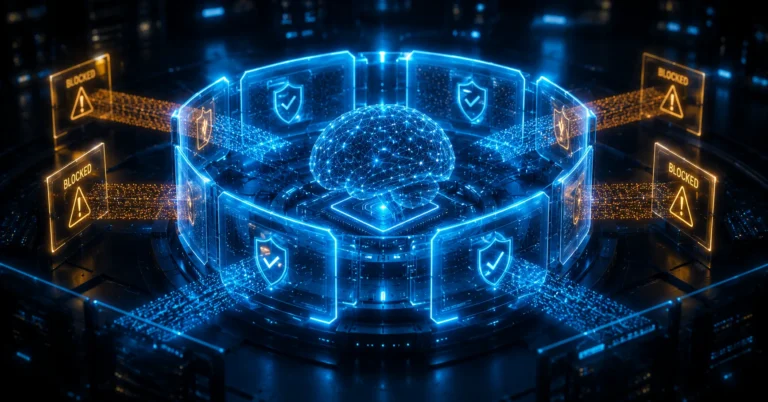
Guardrails for generative AI: safety barriers in production
Guardrails for generative AI: what they are, input, output and action types, defence against prompt injection, common mistakes and how to validate them.
Read article
Secure enterprise RAG: architecture, data leaks and the EU AI Act
Secure enterprise RAG: reference architecture, data-leak risks, EU AI Act compliance and a checklist to go to production without red audits.
Read article
Shadow AI in the company: how to govern AI use without slowing productivity
Shadow AI in the company: how to detect, measure and govern employees’ AI use without slowing productivity or breaking compliance.
Read article
Immutable backups and ransomware recovery: from plan to rehearsal
What makes a backup immutable, why ransomware goes for the backup first, and how to move from a continuity plan to a real rehearsal under DORA and NIS2.
Read article
Patch and vulnerability management under NIS2: who is accountable and with what evidence
What NIS2 requires on vulnerabilities, how to document exceptions that survive an audit, and the evidence chain you need to be able to reconstruct.
Read article
AI in the SDLC: integrating artificial intelligence into secure development
How to integrate AI into the SDLC (development life cycle) without compromising security: phases, risks, governance and compliance in regulated projects.
Read article
Claude Mythos cybersecurity: when AI surpasses hackers
Claude Mythos cybersecurity: analysis of Anthropic’s experiment, its offensive and defensive implications and AI governance.
Read article