PMO agent architecture: how to design an AI agent for a PMO
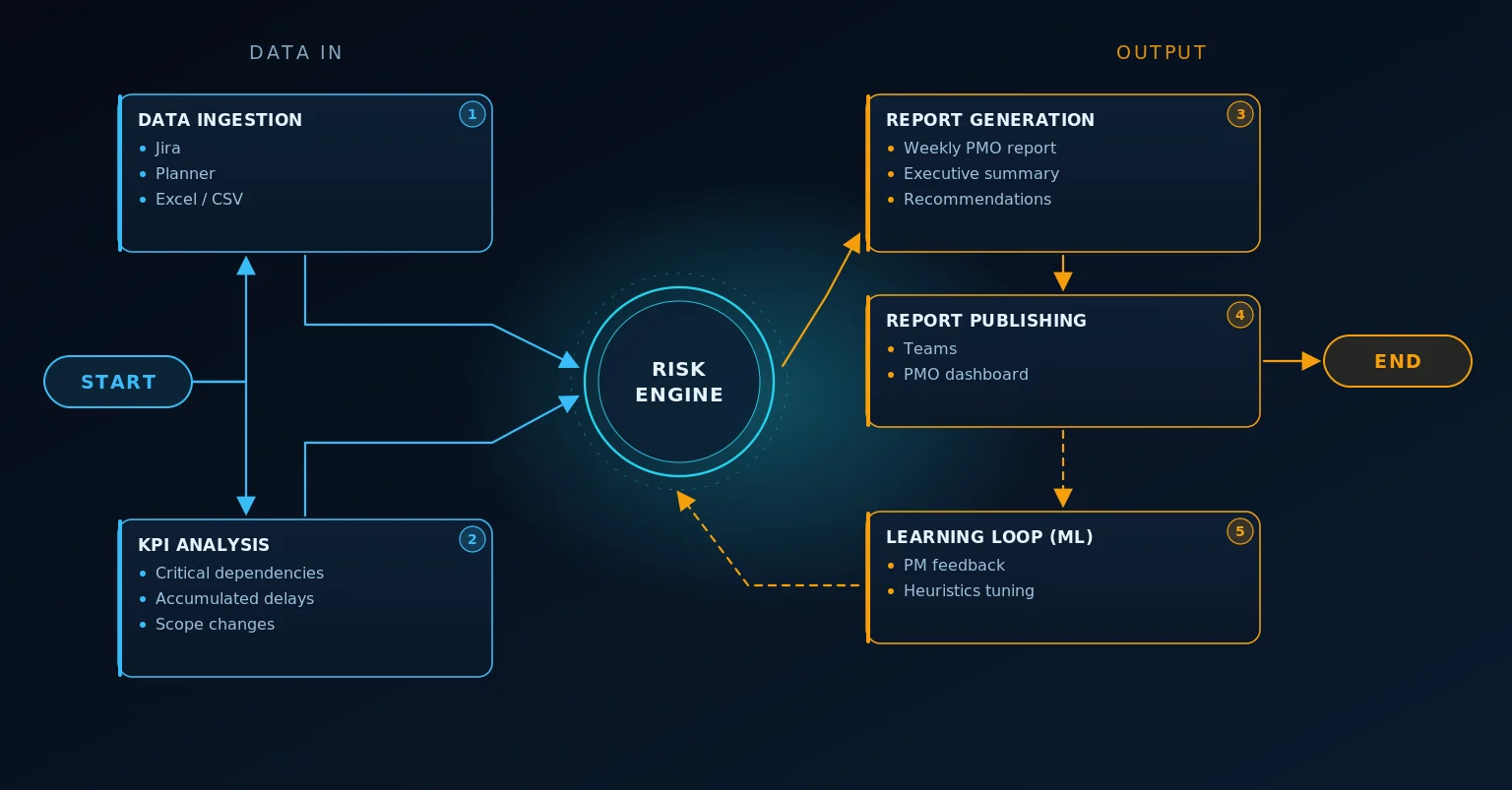
Designing an autonomous agent that operates within a PMO is not the same as building a chatbot or automating an isolated task. The PMO agent architecture defines how the system perceives its environment, reasons, decides and executes actions with human supervision. Few organisations approach these projects with the architectural rigour they deserve, and the result is usually an impressive prototype that does not scale to production. In this article we go into the technical detail: what components an AI agent needs for a PMO, how they connect and what patterns really work in corporate environments.
PMO agent architecture: the four functional blocks
This type of system is organised into four clearly differentiated functional blocks: perception, memory, reasoning and action. Each block has specific responsibilities and communicates with the others through well-defined interfaces.
PMO agent architecture: perception
Moreover, the perception block is how the agent “sees” the world. In a PMO, this means connectors to the projects’ sources of truth: management tools (Jira, Asana, MS Project), documentary repositories (SharePoint, Confluence), communication systems (Teams, Slack, email) and financial databases. The agent can detect a delay, an emerging risk or a change of scope as soon as it happens.
Memory: context and learning
On the other hand, an agent without memory makes decisions on isolated information. The design needs two types of memory: a short-term memory (the context of the current conversation or case) and a long-term memory (history of past decisions, lessons learned, patterns from similar projects). Vector stores and knowledge bases are the typical technologies for implementing these components.
PMO agent architecture: reasoning engine
The reasoning engine is the brain of the agent. This block combines language models with structured logic to make decisions aligned with the organisation’s policies.
PMO agent architecture: the LLM as the core
For this reason, an advanced language model (GPT-4, Claude, Gemini) acts as the central component of the reasoning. However, an LLM on its own is not enough for a corporate PMO: it needs to be wrapped in an orchestration layer that controls its outputs and validates them against business rules.
Orchestration frameworks
Frameworks such as LangGraph or Semantic Kernel make it possible to build stateful multi-step flows, where the agent can plan, execute subtasks, validate results and decide the next step. The agent’s behaviour stops being unpredictable and becomes auditable.
Business rules and policies
On the other hand, critical decisions must not be delegated entirely to the LLM. Because of this, the design includes a rules engine that validates the model’s outputs against corporate policies: approval limits, regulatory requirements, escalation criteria. If the agent proposes approving a budget deviation above the authorised threshold, the rules engine blocks the action and escalates to the competent human.
PMO agent architecture: action block
Undoubtedly, the action block is where the agent interacts with systems and people. This is where many implementations fail by not distinguishing between reversible and irreversible actions.
Automated vs. supervised actions
In this context, the design must classify actions into three levels: automatic execution (low-risk and easily reversible actions, such as generating a report), execution with human confirmation (medium-risk actions, such as rescheduling a milestone) and mandatory escalation (critical actions, such as cancelling a contract). The flow design must make explicit what level of supervision each type of action requires.
Connectors and integration
Moreover, technical connectors (REST APIs, webhooks, message queues) are the fabric that allows the agent to actually execute its decisions. Finally, a good design uses patterns such as Model Context Protocol (MCP) to standardise integration with external tools, avoiding building ad-hoc connectors for each system. I develop this in detail in my guide on MCP in enterprise projects.
PMO agent architecture: the flow of a decision
On the other hand, let’s look at how a typical decision flows through the architecture. This example illustrates how the four blocks combine in a real case.
Example: detecting and handling a risk
For example, suppose the agent detects that a sprint is running 30% behind the plan. The flow would be as follows: the perception block receives the signal from Jira; the memory block retrieves the history of similar projects and the PMO’s escalation criteria; the reasoning engine evaluates whether it is a significant deviation and generates three handling options; the rules engine validates that no option exceeds the organisation’s policies; finally, the action block presents the options to the Project Manager for their decision, or executes the recommended one directly if the risk level allows it.
Traceability and auditing
Every step of this flow must be recorded: what data the agent had, what it reasoned, what it decided, who validated it. The design must include a structured logging system that makes it possible to audit any decision after the fact, especially in environments regulated by NIS2, DORA or the EU AI Act.
PMO agent architecture: security and governance
Finally, a corporate architecture requires security and governance layers that rarely appear in agent tutorials.
PMO agent architecture: identity and permissions
The agent must operate as a corporate identity of its own, with specific permissions assigned through least-privilege principles. Access tokens must be rotated automatically, sessions must have expiry and every action must be attributed unambiguously.
Kill switch and cost limits
Moreover, every design must include a “kill switch” that makes it possible to deactivate the agent immediately if its behaviour deviates. Cost limits (tokens consumed, external API calls, execution time) must be predefined to avoid runaway consumption from loops or reasoning errors.
Regulatory compliance
On the other hand, according to the EU AI Act, AI systems that make decisions with an impact on people or critical resources may be classified as “high-risk”. The regulatory classification must be done at the start of the project and shape the entire architectural design.
In conclusion, the PMO agent architecture is an engineering exercise that combines language models, orchestration, integration and governance. Shortcuts that skip any of these blocks produce flashy but fragile prototypes. By contrast, organisations that invest in a solid architecture build agents that scale, can be audited and generate real value for the PMO for years.
To understand the complete ecosystem: autonomous AI agents in project management and IT project management trends.
Frequently asked questions
A well-designed PMO agent architecture executes concrete tasks in the project life cycle: it reads documentation, synthesises statuses, detects risks before a human does and triggers predefined actions. It does not replace the person, it frees up time for decisions that do require judgement.
Start with ingestion and normalisation of the PMO’s data (Jira, Confluence, plan spreadsheets), then a risk analysis module and, in the final phase, the orchestration one with actions in tools. If you start with orchestration without clean data, the agent will hallucinate.
Three main ones: hallucinations that generate false decisions, exposure of sensitive data if you do not isolate the context, and model drift if you do not audit prompts and results. They are mitigated with human validation, strict RBAC and traceability of every call.
No. A PM with judgement, an engineer familiar with LLMs and security support are enough for a first functional version. What matters is defining the scope, not accumulating headcount. I have seen PMO agents in production built in six weeks by teams of three people. What almost always fails is not the headcount, it is the lack of judgement about what to automate first.
Three non-negotiable layers: role-based access control with the least-privilege principle, an auditable record of every decision the agent makes and mandatory human review for actions that affect budget, scope or people. Without these three controls the agent is an operational risk rather than a help. Governance is designed from the very first prompt.
Are you taking AI from pilot to real work? Let us talk.
Book 20 minutes