Digital legacy: protect your inheritance online
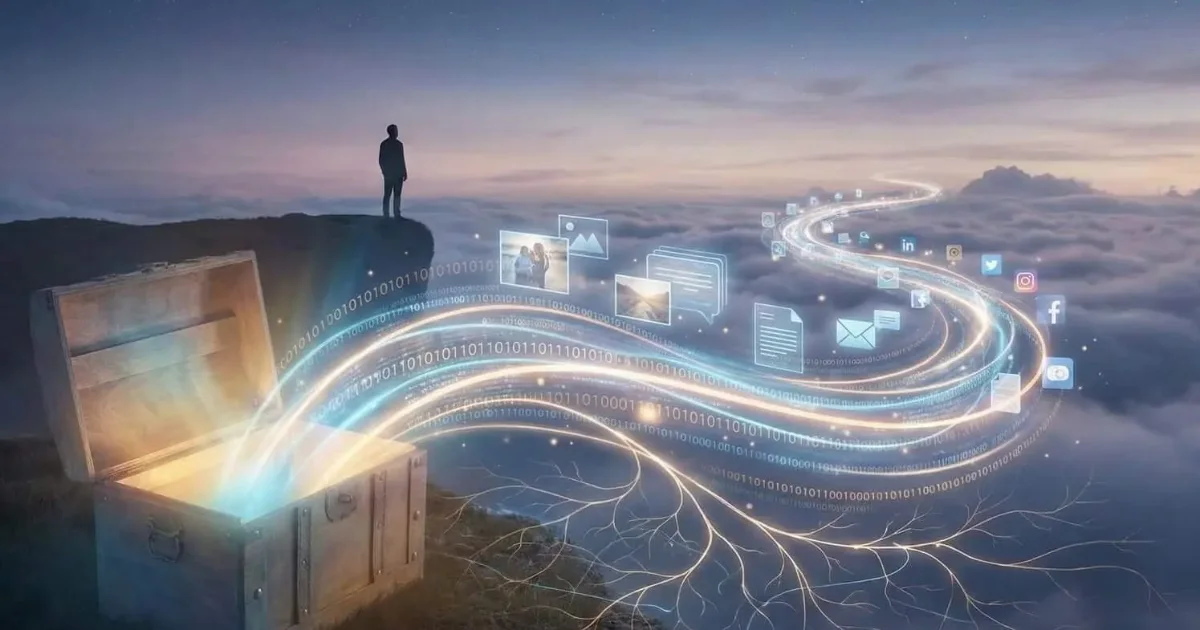
Today, our lives unfold in both the physical and the virtual world. Yet we often forget what will happen to our information when we are no longer here. For this reason, the digital legacy has become a fundamental planning need in modern society. In this article, we explore how to organise our digital estate to protect our privacy and make the process easier for our loved ones.
Failing to plan the digital legacy can expose our privacy to risks of impersonation, the permanent loss of memories or unauthorised access to financial assets. We must treat our data with the same importance as our material possessions. If you are interested in understanding how we have come to depend so much on the digital, I recommend my reflection on the journey from Ibertex to artificial intelligence.
Digital legacy: what it covers and why it matters
We must understand that the digital legacy covers much more than we usually imagine. It is not just social media profiles: it includes email accounts, cloud storage, digital subscriptions, cryptocurrencies, web domains, software licences, music and video libraries, and financial assets managed online.
Data that does not disappear on its own
What is more, this data does not disappear by itself when we die. Without prior planning, access to this information can become a legal and technical maze for our relatives. Because of this, the digital legacy seeks to give a clear destination to our online footprint.
According to OCU, planning your digital estate is a growing need, as millions of profiles of deceased people remain active on social media without supervision. The scale of the problem is far greater than most people assume. The digital legacy is not a futuristic concern: it is a reality affecting millions of families right now.
Digital legacy: tools to organise it
There are tools designed specifically to make managing your digital legacy easier. Today, the main technology platforms offer mechanisms to plan what happens to our accounts after a period of inactivity.
Google and the Inactive Account Manager
Google lets you configure its Inactive Account Manager, where you can decide what happens to your Gmail, Google Drive, YouTube and other services if you stop using them for a set period. You can also designate up to 10 trusted people who will receive access to your data or a notification.
Facebook and the legacy contact
Facebook, meanwhile, lets you designate a legacy contact: a person who can manage your profile in memorial mode after your death. You can also choose to have your account permanently deleted. Apple, Microsoft and other platforms offer similar mechanisms that are worth configuring.
Password managers and documentation
Configuring these options on each platform is not enough. The best practice is to centralise all the information in a password manager (such as Bitwarden, 1Password or KeePass) and leave clear instructions to a trusted person on how to access that manager. Finally, including the digital legacy in your notarised will is a measure that more and more specialised lawyers recommend.
Digital legacy and the legal framework in Spain
Without doubt, the legal dimension of the digital legacy is one of the most complex aspects. In Spain, Organic Law 3/2018 on Data Protection (LOPDGDD) includes Article 96, which specifically regulates the right to a digital will.
Article 96 of the LOPDGDD
This article establishes that heirs, or people linked to the deceased by family or de facto ties, may request access to, rectification of or the erasure of their personal data. There is a legal framework that protects the right to manage a deceased person’s digital legacy. In addition, the article allows the deceased to have designated, during their lifetime, a person to carry out these instructions.
Documenting our digital wishes is not just good practice: it has legal backing. For this reason, including specific clauses about the digital legacy in a will is an increasingly common recommendation among Spanish notaries. To better understand how risk management also applies to our digital assets, you can read my article on risk management in cybersecurity.
Digital legacy and artificial intelligence: ethical dilemmas
On the other hand, managing the digital legacy raises profound ethical dilemmas, especially with the rise of artificial intelligence. Could an AI recreate our personality based on our data? Is it ethical to train a chatbot on a deceased person’s messages so their relatives can “talk” to them?
Deepfakes and posthumous impersonation
Furthermore, deepfake technology makes it possible to generate hyper-realistic videos and audio of people who are no longer with us. Because of this, the risk of posthumous impersonation is greater than ever. A well-planned digital legacy can include explicit instructions on the use (or the prohibition of use) of our data to train AI models. If you are interested in the impact of AI-powered cybercrime, I recommend my analysis on AI cybercrime 2026: deepfakes and phishing.
The intersection between digital legacy and AI forces us to reflect on the ethical limits of technology. This is one of the questions we explore from a practical perspective in AI Forge. If you are interested in how AI shapes our identity and critical capacity, you can read my post on the cognitive footprint of artificial intelligence.
Digital legacy: protection and post-mortem cybersecurity
In this context, cybersecurity plays a fundamental role in protecting the digital legacy. The accounts of deceased people that remain active without supervision are a common target for cybercriminals: phishing aimed at relatives, identity theft and access to financial information.
Essential protection measures
It is essential that the digital legacy plan includes security measures such as multi-factor authentication on all accounts, periodic review of active sessions and the designation of an emergency contact with technical knowledge. We minimise the attack surface even after death.
To understand the differences between the various protection approaches, I recommend my article on the differences between cybersecurity, IT security and information security. In addition, artificial-intelligence literacy is key to making informed decisions about what data we share and how we protect it.
Digital legacy: a practical guide to start today
Organising our digital legacy is an act of responsibility towards ourselves and towards those we leave behind. Because the internet never forgets, planning is the only way to ensure our memory is treated with respect.
Immediate steps
To start today, I recommend following these steps: make a complete inventory of your digital accounts (email, social media, banking, cloud, subscriptions); configure Google’s Inactive Account Manager and Facebook’s legacy contact; centralise your passwords in a secure manager; designate a trusted person and share access to the manager with them; and finally, consult a lawyer about including a digital-legacy clause in your will.
In conclusion, the digital legacy is neither a minor nor a distant matter. It is a reality that affects us all in the connected society of 2026. Our dependence on the digital keeps growing, as I analyse in my reflection on technological evolution and human degradation. The best way to protect our digital identity beyond our physical presence is to act now, with the tools and legal framework we already have at our disposal.
- From Ibertex to AI: 40 years of digital evolution
- Cybersecurity risk management: a strategic guide
- AI cybercrime in 2026: deepfakes, phishing and defence
- The cognitive footprint of AI
- Cybersecurity and IT security: key differences
- AI literacy: the skill of the 21st century
- Technological evolution and human degradation
Do you have to apply this under DORA, NIS2 or ENS? Tell me about it.
Book 20 minutes